History: CLWE 2008 article TODOs
Preview of version: 8
Use this page to keep track of things to do.
Limit is 15 pages. Is there an easy way to render these wiki pages using the WS08 Latex format, so we can see how many pages it gives?
Formats are on this page:
http://www.acm.org/sigs/publications/proceedings-templates
The WS08 CFP does not say if we have can use Option 2 (Tighter Alternate style which may reduce the total number of pages). I (AD) say we go for Strict adherence to ACM SIG, and if we find we are over 15 pages, then use the tighter version. If the WS08 complains, we can later reduce its length to fit the Strict adherance template.
For example, "linguistic variant" to refer to something like "The English version of page X". This is better than using "version" which is ambiguous (it could refer to something like v1.2 of the page versus v1.3 of the page). Also, I used the term "edit" instead of "content element". I think it more correctly describes what it is.
We need to make sure we use the vocabulary consistently throughout the paper.
At the very end.
Make sure that the Storyboard includes a case like this.
Here's a description of how this can happen:
[12:05:43 PM] Alain Désilets says: EN = {e1} [12:05:47 PM] Alain Désilets says: FR = {e2} [12:06:07 PM] Alain Désilets says: FR importe e1 de EN. [12:06:09 PM] Alain Désilets says: on a [12:06:14 PM] Alain Désilets says: EN = {e1} [12:06:18 PM] Alain Désilets says: FR = {e1, e2} [12:08:12 PM] Alain Désilets says: EN veut importer e2 de FR. [12:08:20 PM] Alain Désilets says: mais quand il le fait, il va voir et e1 et e2 [12:09:21 PM] Alain Désilets says: Le système sait que EN a déjà e1. Mais le diff n'est pas capable de l'isoler. [12:10:01 PM] Alain Désilets says: On pourrait pas faire un diff de fr entre la révision ou e2 est apparue en premier, et la révision précédente. [12:10:44 PM] Alain Désilets says: Mais le problème, c'est comment présenter ce diff de e2 dans un "inline diff" pour la version de FR qui contient maintenant et e1 et e2. [12:10:53 PM] Louis-Philippe Huberdeau says: Oui. Ici, on a un cas simple qui le montre, mais il y a des cas beaucoup plus complexes
Some of it may be re-threaded in the present argumentation.
In order to illustrate how CLWE supports unconstrained collaborative authoring and editing, we now describe a detailed usage storyboard. This storyboard involves three people (JohnDoe, MarieQuidam and CarloDelPueblo) collaboratively writing a technical report for a project in 3 languages at once (English, French and Spanish). For simplicity sake, we assume all three of them to be trilingual but that each of them are only changing the page in their native language. But note that the system does not require that to be the case.
First, John Doe creates an English page in two consecutive edits.
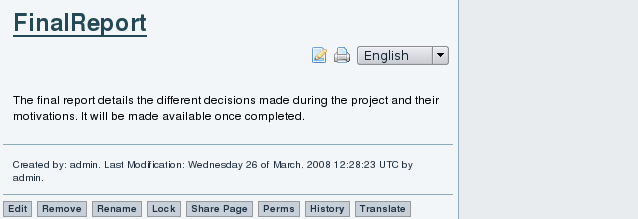
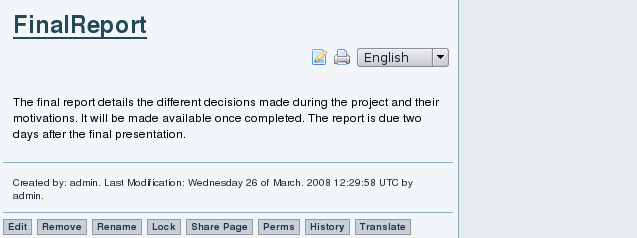
At this point, we have:
en_v2 = {e1, e2}
fr = None
es = None
At this point, Marie Quidam and Juan del Pueblo translate the English page to French and Spanish respectively. NOTE from AD: It's too bad that we don't have screen shot of what the translation UI looks like, the Under translation notices etc...
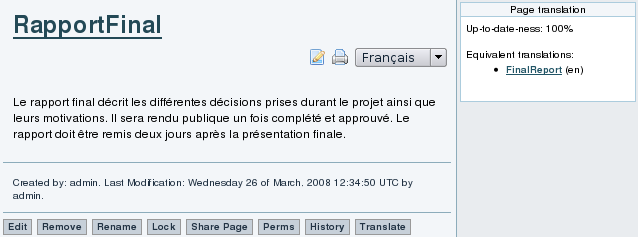
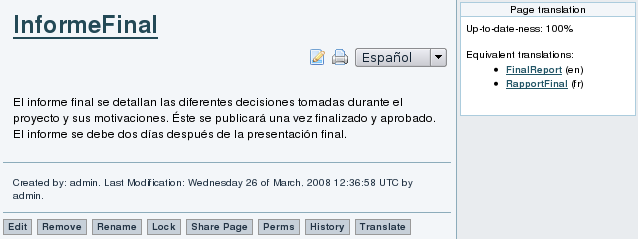
At this point, we have:
en_v2 = {e1, e2}
fr_v1 = {e1, e2}
es_v1 = {e1, e2}
And all pages are displayed as being up to date. At this point, Marie adds a list of bullet points to the French version. NOTE AD: Too bad we don't have a screen shot of Frenh with the bulet points. At this point, we have:
en_v2 = {e1, e2}
fr_v2 = {e1, e2, e3}
es_v1 = {e1, e2}
Both English and Spanish are displayed as being out of date ("22% up to date") like thus:
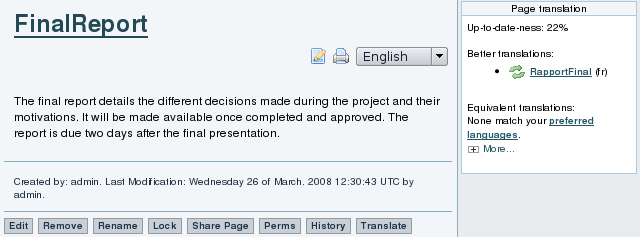
and they provide links to view the "better" French version, and update from it (the green double arrow icon).
At this point, John decides to update the English version from the French, by clicking on the double green arrow icon in front of the French page name.
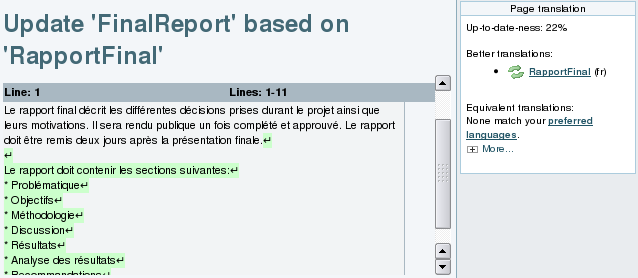
The system shows John the French changes that need to be reproduced in English (changes highlighted in green). John copies and pastes them to the Englsh edit field (not visible here... which is unfortunate), and starts overwriting them with their English translation. He then saves it.
At this point, we have:
en_v3 = {e1, e2, e3}
fr_v2 = {e1, e2, e3}
es_v1 = {e1, e2}
The English is now shown as being up to date, but the Spanish is still behind. But Juan who looks after the Spanish version is not in the mood for translating right now, and wants to add original content instead. No problem, he can do that. He adds the exact dates of the event along with the location {es_v2}. The page indicates that the page does contain additional content. However, more content can be obtained from the French and English versions. NOTE from AD: Hum... seems that the image for this transaction is wrong. I don't see dates added!
We now have:
en_v3 = {e1, e2, e3}
fr_v2 = {e1, e2, e3}
es_v1 = {e1, e2, e4}
and all three versions are considered to need updating. Now that Juan has gotten his original edits out of the way, he is in the mood for translating changes from English. After he is done, we have:
en_v3 = {e1, e2, e3}
fr_v2 = {e1, e2, e3}
es_v1 = {e1, e2, e3, e4}
which means that Spanish is completely up to date, but French and English need updating from Spanish.
Images below need to be threaded in the above discussion
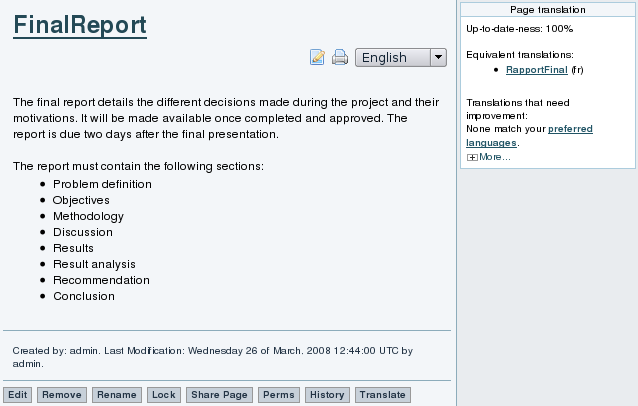
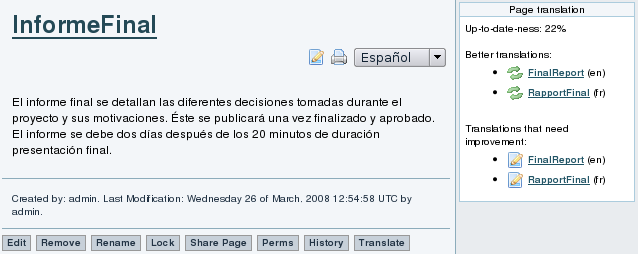
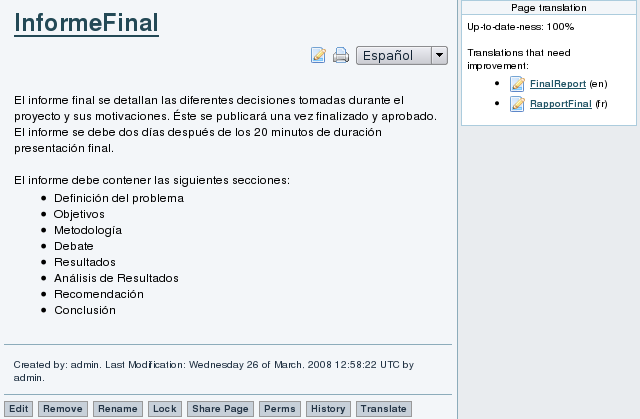
As it can be seen in the scenario, to a content contributor, the translation process is invisible. As any visitor of the website, the contributor will see the "Page Translation" box presenting the different alternatives and status information. However, he is free to ignore it. When a change is made by a content contributor, a new original content contribution is recorded and other linguistic versions of the page get updated with the information.
The "Page Translation" box provides links for translators to view the relevant changes made to the page. When using those links, the translator is brought to a slightly different version of the edit page. The page displays the changes to be translated along with the text area. When the translator indicates that the translation of the changes is completed, the translation target gets marked as containing the changes provided by the translation source. Again, other linguistic versions of the page get updated with the new information.
The directed graph representation of the described scenario can be illustrated as in figure {architecture_graph.dot.png}. In the graph, white nodes are original content contributions and gray nodes are versions resulting from a translation efforts. Solid arcs are page evolutions from version to version and dashed arcs are translations from source to target. On each node, the original content contributions included in the version are listed on the second row.
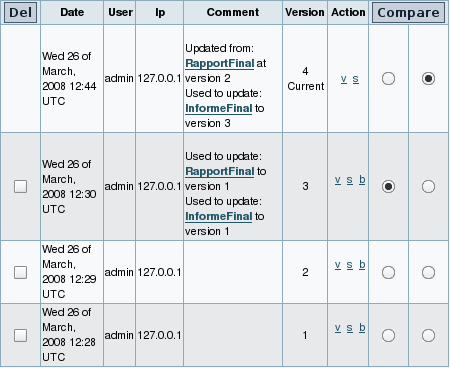
The graph representation is in fact very close to the internal representation used. Beyond providing useful information for the site visitors and support translators, the entire translation history is preserved. Figure {en_history} presents the page history of the English page in the scenario. The information from the translation history will allow to analyze the translation patterns and evolution of the communities around the different linguistic versions of a page.
First, John Doe creates English page Final Report in two consecutive edits. We now have:
en_v2 = {e1, e2}
fr = None
es = None
Then, Marie Quidam sees the English page, and hits the Traduire ("Translate") button. She enters French as the target language, and Rapport Final as the name of the target page. The system pastes the content of the English page Final Report into an edit box, and inserts a note "Under translation" at the top. Marie translates the first sentence, when the phone rings. She hits the Traduction Partielle ("Partial Translation") button and answers the phone. The status of the various pages is now:
en_v2 = {e1, e2}
fr_v1 = {}
es = None
The sytem shows the pages as not being up to date, because it says that the en version is "better". When Marie comes back from her phone conversatio, she clicks on the update icon in front of Final Report (en), translates the remaining two sentences, and this time hits the Complete Translation button, to signal that she is done translating. Note however that Marie forgets to delete the Under translation line at the top of the page.
We now have:
en_v2 = {e1, e2}
fr_v2 = {e1, e2}
es = None
and the French version Rapport Final is now displayed as being equivalent to the English Final Report. Later, Juan Del Pueblo sees the French page, hits the ??? ("Translate") button and translates the whole content in one go, making sure to save using the ??? ("Complete Translation") button. We now have:
en_v2 = {e1, e2}
fr_v2 = {e1, e2}
es_v1 = {e1, e2}
and the Spanish page Informe Final is listed as being equivalent to both the English and French versions. Now, Marie notices that she forgot to erase the Under translation line at the top of the French page. So she edits it, erases the page, and saves using the Modif. Mineure ("Minor Change") button. This means that the change is not considered as a change that needs translation. So the state of the three pages remains the same, and they are still displayed as being up to date with each other.
Next, John Doe adds three bullet points to the English version of the page. We now have:
en_v3 = {e1, e2, e3}
fr_v2 = {e1, e2}
es_v1 = {e1, e2}
At this point, the French and Spanish versions are labeled as needing updating from English. But Marie is not in a translation mood and would rather add original content to the French version. No problem, she can do that, and she adds her own two bullet points to the list. We now have:
en_v3 = {e1, e2, e3}
fr_v2 = {e1, e2, e4}
es_v1 = {e1, e2}
At this point, all three versions are labeled as missing some edits. Now that Marie has gotten her original edits out her mind, she is in the mood for translating, and decides to update from the English version (by clicking on the double green arrows in front of the English page name). The changes to be translated are highlighted in green at the top of the screen. Marie copies and pastes it into the French edit field, then translates it to French and saves as a complete translation. We now have:
en_v3 = {e1, e2, e3}
fr_v3 = {e1, e2, e3, e4}
es_v1 = {e1, e2}
The French version is the most up to date, but English and Spanish still needs to be updated. Now, Juan wants to bring Spanish up to date. He can do this either by updating from English or French.
What next... Maybe Marie can now incorporate John's changes, and later on, Juan can decide which of EN or FR to update from... Q: Does the tool help him make that decision?
NOTES FROM AD: Storyboard below is being replaced by new storyboard above
First, John Doe creates a page in English, in two consecutive edits.
TO BE INSERTED HERE: Screen shot of the EN page
en_v2 = {e1, e2}
es = None
fr = None
Then, Juan Del Pueblo decides to translate it to Spanish.
TO BE INSERTED HERE: Screen shot of the dialog where he enters the language and name of target page
TO BE INSERTED HERE: Screen shot of the initial translation dialog, with the En content pasted into the ES page, with the note at the top saying it's under translation
Note how the system automatically pasted the English content into the Spanish page, and inserted a noted at the top saying that it is under translation. Juan translatest the whole text in one go, and therefore erases the "Translation in Progress" notice. He saves the translation using the "Complete Translation" button.
TO BE INSERTED HERE: Screen shot of EN page, with 100% up to date notice, and a link to the EN
We now have:
en_v2 = {e1, e2}
es_v1 = {e1, e2}
fr = None
In other words, English and Spanish both contain the same edits, and there are no other linguistic versions that contain additional edits. This is reflected on the screen by the fact that the Spanish page lists the English page as an "equivalent translation", and it says that the Spanish version is "100% up to date".
Next, Marie Quidam sees the English page, and decides to translate it to French. She pushes on the "Translate" button, enters French as the language, and the name of the French page. But just as she is about to overwwrite the English content with its French translation, the phone rings. So she presses on the "Partial Translation" button.
TO BE INSERTED HERE: Screen shot of FR page, with Spanish content in it and still the English content
We now have:
en_v2 = {e1, e2}
es_v1 = {e1, e2}
fr_v1 = {}
Note how the French version is still assumed to not contain any of the edits from the English, because Marie saved the page as a "Partial Translation" and the system has no way of knowing which of e1 and e2, if any, has been translated at this point. This is reflected on the screen since the French page lists both English and Spanish as being "better" translations. It also says that the French version is 66% up to date (note: we will explain later how this number is callculated and why in this case, it's not 0%).
At this point, John Doe decides to add more content to the English page. This time though, the edit he does needs to be translated to all the other languages ASAP. So John checks the "Send urgent translation request" box before saving his edit.
TO BE INSERTED HERE: Screen shot of FEN page being edited and about to be saved, with the "Send urgent translation request" check box selected
We now have:
en_v2 = {e1, e2, e3*}
es_v1 = {e1, e2}
fr_v1 = {}
where the asterisk beside e3 denotes that this edit needs to be urgently translated. At this point, Juan looks at the Spanish page and sees the urgent translation notice at the top, and decides to do something about it. He clicks on the double green arrows icon in front of the English page name. The system shows him the content of the urgent edit e3* at the top, along with an edit box at the bottom with the Spanish content. Juan copies and pastes the English e3* content into the Spanish page, and overwrites it with its Spanish translation. He saves it as a complete translation.
TO BE INSERTED HERE: Screen shot of ES page without the Urgent translation request anymore
We now have:
en_v2 = {e1, e2, e3*}
es_v1 = {e1, e2, e3*}
fr_v1 = {}
In other words, Spanish is completely up to date, including the urgent edit, and this is reflected on the screen by the disappearance of the urgent translation notice.
Later still, Marie comes back from her phone conversation and decides to pickup the translation from English to French.
TO BE INSERTED HERE: Screen shot of French being translated from EN. The whole EN content is highligted (NOTE: IN RICK'S SNAPSHOT, ONLY PART OF THE EN CONTENT IS SELECTED. LPH THINKS IT'S BECAUSE RS MOCKED AROUND WITH PAGES IN WEIRD WAYS, TRANSLATING PAGES THAT ALREADY EXISTED, ETC... INITIALISATION OF HIS SITE WAS A BIT WEIRD IN OTHER WORDS. NORMALLY, THIS SHOULD NOT HAPPEN)
Since Marie previously saved her translation as "partial", the system does not know which of e1 or e2 has been propagated to French. Therefore it highlights both of them (which in this case turns out to be the whole English content). Marie does more of the translation but still saves it as saves is as a "Complete" translation.
Submission deadline: May 3rd!!
Start keeping track of how many pages we have.
Limit is 15 pages. Is there an easy way to render these wiki pages using the WS08 Latex format, so we can see how many pages it gives?
Formats are on this page:
http://www.acm.org/sigs/publications/proceedings-templates
The WS08 CFP does not say if we have can use Option 2 (Tighter Alternate style which may reduce the total number of pages). I (AD) say we go for Strict adherence to ACM SIG, and if we find we are over 15 pages, then use the tighter version. If the WS08 complains, we can later reduce its length to fit the Strict adherance template.
Need a consistent good vocabulary to describe things
For example, "linguistic variant" to refer to something like "The English version of page X". This is better than using "version" which is ambiguous (it could refer to something like v1.2 of the page versus v1.3 of the page). Also, I used the term "edit" instead of "content element". I think it more correctly describes what it is.
We need to make sure we use the vocabulary consistently throughout the paper.
Spell check the whole thing
At the very end.
Talk about scenarios of "cross-translation"
Make sure that the Storyboard includes a case like this.
Here's a description of how this can happen:
[12:05:43 PM] Alain Désilets says: EN = {e1} [12:05:47 PM] Alain Désilets says: FR = {e2} [12:06:07 PM] Alain Désilets says: FR importe e1 de EN. [12:06:09 PM] Alain Désilets says: on a [12:06:14 PM] Alain Désilets says: EN = {e1} [12:06:18 PM] Alain Désilets says: FR = {e1, e2} [12:08:12 PM] Alain Désilets says: EN veut importer e2 de FR. [12:08:20 PM] Alain Désilets says: mais quand il le fait, il va voir et e1 et e2 [12:09:21 PM] Alain Désilets says: Le système sait que EN a déjà e1. Mais le diff n'est pas capable de l'isoler. [12:10:01 PM] Alain Désilets says: On pourrait pas faire un diff de fr entre la révision ou e2 est apparue en premier, et la révision précédente. [12:10:44 PM] Alain Désilets says: Mais le problème, c'est comment présenter ce diff de e2 dans un "inline diff" pour la version de FR qui contient maintenant et e1 et e2. [12:10:53 PM] Louis-Philippe Huberdeau says: Oui. Ici, on a un cas simple qui le montre, mais il y a des cas beaucoup plus complexes
Misc content removed from the Storyboard section
Some of it may be re-threaded in the present argumentation.
Old Scenario by LPH
The screenshots of this scenario are using the most recent version of CLWE. But there are some key screens missing if we want to tell the full story
In order to illustrate how CLWE supports unconstrained collaborative authoring and editing, we now describe a detailed usage storyboard. This storyboard involves three people (JohnDoe, MarieQuidam and CarloDelPueblo) collaboratively writing a technical report for a project in 3 languages at once (English, French and Spanish). For simplicity sake, we assume all three of them to be trilingual but that each of them are only changing the page in their native language. But note that the system does not require that to be the case.
First, John Doe creates an English page in two consecutive edits.
At this point, we have:
en_v2 = {e1, e2}
fr = None
es = None
At this point, Marie Quidam and Juan del Pueblo translate the English page to French and Spanish respectively. NOTE from AD: It's too bad that we don't have screen shot of what the translation UI looks like, the Under translation notices etc...
At this point, we have:
en_v2 = {e1, e2}
fr_v1 = {e1, e2}
es_v1 = {e1, e2}
And all pages are displayed as being up to date. At this point, Marie adds a list of bullet points to the French version. NOTE AD: Too bad we don't have a screen shot of Frenh with the bulet points. At this point, we have:
en_v2 = {e1, e2}
fr_v2 = {e1, e2, e3}
es_v1 = {e1, e2}
Both English and Spanish are displayed as being out of date ("22% up to date") like thus:
and they provide links to view the "better" French version, and update from it (the green double arrow icon).
At this point, John decides to update the English version from the French, by clicking on the double green arrow icon in front of the French page name.
The system shows John the French changes that need to be reproduced in English (changes highlighted in green). John copies and pastes them to the Englsh edit field (not visible here... which is unfortunate), and starts overwriting them with their English translation. He then saves it.
At this point, we have:
en_v3 = {e1, e2, e3}
fr_v2 = {e1, e2, e3}
es_v1 = {e1, e2}
The English is now shown as being up to date, but the Spanish is still behind. But Juan who looks after the Spanish version is not in the mood for translating right now, and wants to add original content instead. No problem, he can do that. He adds the exact dates of the event along with the location {es_v2}. The page indicates that the page does contain additional content. However, more content can be obtained from the French and English versions. NOTE from AD: Hum... seems that the image for this transaction is wrong. I don't see dates added!
We now have:
en_v3 = {e1, e2, e3}
fr_v2 = {e1, e2, e3}
es_v1 = {e1, e2, e4}
and all three versions are considered to need updating. Now that Juan has gotten his original edits out of the way, he is in the mood for translating changes from English. After he is done, we have:
en_v3 = {e1, e2, e3}
fr_v2 = {e1, e2, e3}
es_v1 = {e1, e2, e3, e4}
which means that Spanish is completely up to date, but French and English need updating from Spanish.
Images below need to be threaded in the above discussion
As it can be seen in the scenario, to a content contributor, the translation process is invisible. As any visitor of the website, the contributor will see the "Page Translation" box presenting the different alternatives and status information. However, he is free to ignore it. When a change is made by a content contributor, a new original content contribution is recorded and other linguistic versions of the page get updated with the information.
The "Page Translation" box provides links for translators to view the relevant changes made to the page. When using those links, the translator is brought to a slightly different version of the edit page. The page displays the changes to be translated along with the text area. When the translator indicates that the translation of the changes is completed, the translation target gets marked as containing the changes provided by the translation source. Again, other linguistic versions of the page get updated with the new information.
The directed graph representation of the described scenario can be illustrated as in figure {architecture_graph.dot.png}. In the graph, white nodes are original content contributions and gray nodes are versions resulting from a translation efforts. Solid arcs are page evolutions from version to version and dashed arcs are translations from source to target. On each node, the original content contributions included in the version are listed on the second row.
The graph representation is in fact very close to the internal representation used. Beyond providing useful information for the site visitors and support translators, the entire translation history is preserved. Figure {en_history} presents the page history of the English page in the scenario. The information from the translation history will allow to analyze the translation patterns and evolution of the communities around the different linguistic versions of a page.
en_history
New scenario created by AD
NOTE: I (AD) have BMP files for each step of the way on my laptop.
CRAP: I created it on wiki-translation site which doesn't have the most recent version! It lacks the X% up to date messages! I will try to construct a story using the screen shots that LPH produced instead.
First, John Doe creates English page Final Report in two consecutive edits. We now have:
en_v2 = {e1, e2}
fr = None
es = None
Then, Marie Quidam sees the English page, and hits the Traduire ("Translate") button. She enters French as the target language, and Rapport Final as the name of the target page. The system pastes the content of the English page Final Report into an edit box, and inserts a note "Under translation" at the top. Marie translates the first sentence, when the phone rings. She hits the Traduction Partielle ("Partial Translation") button and answers the phone. The status of the various pages is now:
en_v2 = {e1, e2}
fr_v1 = {}
es = None
The sytem shows the pages as not being up to date, because it says that the en version is "better". When Marie comes back from her phone conversatio, she clicks on the update icon in front of Final Report (en), translates the remaining two sentences, and this time hits the Complete Translation button, to signal that she is done translating. Note however that Marie forgets to delete the Under translation line at the top of the page.
We now have:
en_v2 = {e1, e2}
fr_v2 = {e1, e2}
es = None
and the French version Rapport Final is now displayed as being equivalent to the English Final Report. Later, Juan Del Pueblo sees the French page, hits the ??? ("Translate") button and translates the whole content in one go, making sure to save using the ??? ("Complete Translation") button. We now have:
en_v2 = {e1, e2}
fr_v2 = {e1, e2}
es_v1 = {e1, e2}
and the Spanish page Informe Final is listed as being equivalent to both the English and French versions. Now, Marie notices that she forgot to erase the Under translation line at the top of the French page. So she edits it, erases the page, and saves using the Modif. Mineure ("Minor Change") button. This means that the change is not considered as a change that needs translation. So the state of the three pages remains the same, and they are still displayed as being up to date with each other.
Next, John Doe adds three bullet points to the English version of the page. We now have:
en_v3 = {e1, e2, e3}
fr_v2 = {e1, e2}
es_v1 = {e1, e2}
At this point, the French and Spanish versions are labeled as needing updating from English. But Marie is not in a translation mood and would rather add original content to the French version. No problem, she can do that, and she adds her own two bullet points to the list. We now have:
en_v3 = {e1, e2, e3}
fr_v2 = {e1, e2, e4}
es_v1 = {e1, e2}
At this point, all three versions are labeled as missing some edits. Now that Marie has gotten her original edits out her mind, she is in the mood for translating, and decides to update from the English version (by clicking on the double green arrows in front of the English page name). The changes to be translated are highlighted in green at the top of the screen. Marie copies and pastes it into the French edit field, then translates it to French and saves as a complete translation. We now have:
en_v3 = {e1, e2, e3}
fr_v3 = {e1, e2, e3, e4}
es_v1 = {e1, e2}
The French version is the most up to date, but English and Spanish still needs to be updated. Now, Juan wants to bring Spanish up to date. He can do this either by updating from English or French.
What next... Maybe Marie can now incorporate John's changes, and later on, Juan can decide which of EN or FR to update from... Q: Does the tool help him make that decision?
NOTES FROM AD: Storyboard below is being replaced by new storyboard above
Other possible scenario based on keyframes from Rick Sapir's video
First, John Doe creates a page in English, in two consecutive edits.
TO BE INSERTED HERE: Screen shot of the EN page
en_v2 = {e1, e2}
es = None
fr = None
Then, Juan Del Pueblo decides to translate it to Spanish.
TO BE INSERTED HERE: Screen shot of the dialog where he enters the language and name of target page
TO BE INSERTED HERE: Screen shot of the initial translation dialog, with the En content pasted into the ES page, with the note at the top saying it's under translation
Note how the system automatically pasted the English content into the Spanish page, and inserted a noted at the top saying that it is under translation. Juan translatest the whole text in one go, and therefore erases the "Translation in Progress" notice. He saves the translation using the "Complete Translation" button.
TO BE INSERTED HERE: Screen shot of EN page, with 100% up to date notice, and a link to the EN
We now have:
en_v2 = {e1, e2}
es_v1 = {e1, e2}
fr = None
In other words, English and Spanish both contain the same edits, and there are no other linguistic versions that contain additional edits. This is reflected on the screen by the fact that the Spanish page lists the English page as an "equivalent translation", and it says that the Spanish version is "100% up to date".
Next, Marie Quidam sees the English page, and decides to translate it to French. She pushes on the "Translate" button, enters French as the language, and the name of the French page. But just as she is about to overwwrite the English content with its French translation, the phone rings. So she presses on the "Partial Translation" button.
TO BE INSERTED HERE: Screen shot of FR page, with Spanish content in it and still the English content
We now have:
en_v2 = {e1, e2}
es_v1 = {e1, e2}
fr_v1 = {}
Note how the French version is still assumed to not contain any of the edits from the English, because Marie saved the page as a "Partial Translation" and the system has no way of knowing which of e1 and e2, if any, has been translated at this point. This is reflected on the screen since the French page lists both English and Spanish as being "better" translations. It also says that the French version is 66% up to date (note: we will explain later how this number is callculated and why in this case, it's not 0%).
At this point, John Doe decides to add more content to the English page. This time though, the edit he does needs to be translated to all the other languages ASAP. So John checks the "Send urgent translation request" box before saving his edit.
TO BE INSERTED HERE: Screen shot of FEN page being edited and about to be saved, with the "Send urgent translation request" check box selected
We now have:
en_v2 = {e1, e2, e3*}
es_v1 = {e1, e2}
fr_v1 = {}
where the asterisk beside e3 denotes that this edit needs to be urgently translated. At this point, Juan looks at the Spanish page and sees the urgent translation notice at the top, and decides to do something about it. He clicks on the double green arrows icon in front of the English page name. The system shows him the content of the urgent edit e3* at the top, along with an edit box at the bottom with the Spanish content. Juan copies and pastes the English e3* content into the Spanish page, and overwrites it with its Spanish translation. He saves it as a complete translation.
TO BE INSERTED HERE: Screen shot of ES page without the Urgent translation request anymore
We now have:
en_v2 = {e1, e2, e3*}
es_v1 = {e1, e2, e3*}
fr_v1 = {}
In other words, Spanish is completely up to date, including the urgent edit, and this is reflected on the screen by the disappearance of the urgent translation notice.
Later still, Marie comes back from her phone conversation and decides to pickup the translation from English to French.
TO BE INSERTED HERE: Screen shot of French being translated from EN. The whole EN content is highligted (NOTE: IN RICK'S SNAPSHOT, ONLY PART OF THE EN CONTENT IS SELECTED. LPH THINKS IT'S BECAUSE RS MOCKED AROUND WITH PAGES IN WEIRD WAYS, TRANSLATING PAGES THAT ALREADY EXISTED, ETC... INITIALISATION OF HIS SITE WAS A BIT WEIRD IN OTHER WORDS. NORMALLY, THIS SHOULD NOT HAPPEN)
Since Marie previously saved her translation as "partial", the system does not know which of e1 or e2 has been propagated to French. Therefore it highlights both of them (which in this case turns out to be the whole English content). Marie does more of the translation but still saves it as saves is as a "Complete" translation.
History
SideMenu

Latest Changes
No records to display ...more
Search
Log In
Upcoming Events
No records to display